
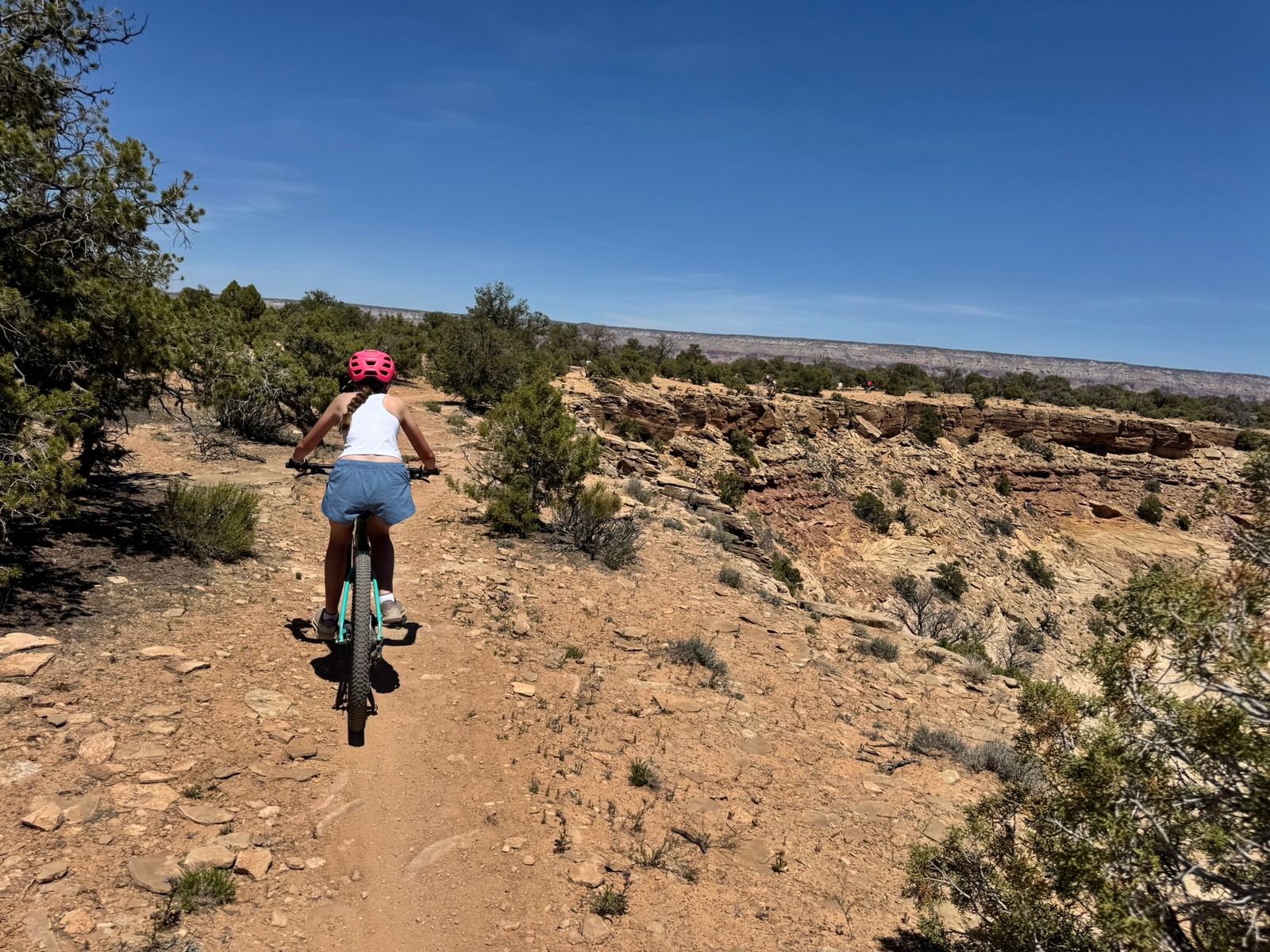
A few months ago we were mountain biking as a family. The order of our ride generally goes something like this: Andrew, our fastest rider, goes first. Then Jacob, our youngest. My wife follows to keep the boys under control, and then our daughter Makayla. I follow up the rear. We don't want to let anyone fall behind. It usually ends up that we're two different groups. So, I usually get the chance to spend some good time with my daughter.
We were on a trail that we tend to do a few times a year. It's a single track trail that follows a canyon rim. Most of the time the trail is far from the edge of the cliff, but every so often the trail meanders closer to the cliff than most people would feel comfortable. The trail is not technically difficult, but there are rocks and bumps along the path that can make it somewhat intimidating for a novice rider.
However, what really gets them distracted is how close to the cliff edge the trail can come at times. Sometimes we're riding 3-4 feet from the edge of the cliff. In these sections it's usually pretty smooth. But my daughter said to me, "I feel like I'm going to ride off the cliff." I just told her to keep her eyes focused on the trail and that would be the direction that she would go. Don't focus on the cliff. Just focus on where you want to go.
In auto racing, there's a name for the danger. It's called target fixation. When you're running down a track at 185 mph, you need to keep your eyes on where you're going, especially as you go into a turn. If you focus your eyes on the wall, the gravel in the turn, or the other driver, you'll have the tendency to crash. Even if you have the mechanical ability to make the turn, more than likely you'll end up on the side of the track. However, if you look into the turn and the direction you're going, chances are you'll get through the turn and you'll be able to accelerate.
Angela Duckworth is an academic I admire, and I have always found her work really fascinating. [In grad school], I gained a lot of insight from her research and it influenced much of what I do to this day. Most of her career has been focused on exploring one question – how do people become top performers? Her first book, Grit, talked a lot about how the mentality to push through a difficult challenge separated the top performers from the rest of the pack. But in her new book, Situated: Find the People and Places That Bring Out Your Best, she talks about how the situation we put ourselves in has as much to do with our success as our attitude. You see, the people we surround ourselves with, the situations we are in, and our environment all have an influence on the outcomes we desire.
For example, if I'm trying to lose weight and I work at the Haagen-Dazs store down the road, chances are I'll never lose weight, even if I have a strong mentality. Why? Because the environment I've put myself into isn't conducive to weight loss (especially if I love ice cream). Maybe, instead, I become a mountain bike instructor. I quit my job at Haagen-Dazs and teach others how to mountain bike. I've done two things – one, I've removed the temptation to eat ice cream (sure, I can still go to the store to buy some) and two, I've put myself into an environment where I'm working out each day. I've restructured my situation to help me achieve my goals.
How often do we look at the person that we want to become and think to ourselves, man, I just need to get better. I can have more willpower. I can do it. Yet, we stumble and fall. I know I've done it and I'd be shocked if you haven't done it. See, we all think that mental toughness is the only key to achieving our goals. Yes, mental toughness is important, I'm not denying that fact. Yet, the situation we put ourselves in can have just as much of an influence as our attitude. In fact, it can have a greater impact.
So, what does this have to do with target fixation? Well, the people we surround ourselves with have a huge influence on what we choose to focus on. You go where you look. And your situation decides where you look. If we want to improve as a father, we need to surround ourselves with people and ideas that will help us be better fathers. If we want to be better professionals, we need to surround ourselves with the people that will make us better. Plain and simple. If you do this, you'll find that the goals you have, the dreams you think you can achieve, will change. It may be slow, but growth is really the point.
I'm now in my mid-40s (yikes!). I know that I have wondered at times, "Is this all there is to my life?" I go to work each day, live in an office for 8 hours, get in my car, drive through traffic for about 30 minutes, get home stressed, help with dinner, put the kids to bed, and by the end of the day, I'm exhausted. I go to bed. And start the day all over again. It's repetitive. It's monotonous. It feels a lot like Groundhog Day! And we wonder, "This is my life?!?"
Now, back to the story where we started. My daughter didn't fall off the cliff. She focused on the trail. And that helped her. When she started focusing on where she wanted to go, it allowed her to focus on what she wanted. She no longer worried about the cliff. Sure, it was still there, but it no longer scared her.
Most of us aren't headed off a cliff. We're just staring at the wrong thing. The routine. The inbox. The drive home.
So where are you looking right now?
See you above the tree line.
That's what Moab is for. A couple days out of your normal situation, with a few other dads, long enough to look up the trail. If you want to start there, take the Wilderness Gap. Eight questions, about four minutes.
https://www.pathforgexp.com/wilderness-gap.html
P.S. Our October group meets in Moab, Oct 23–24. Capped at 8. If you've been thinking about it, hit reply and we'll find 20 minutes.