
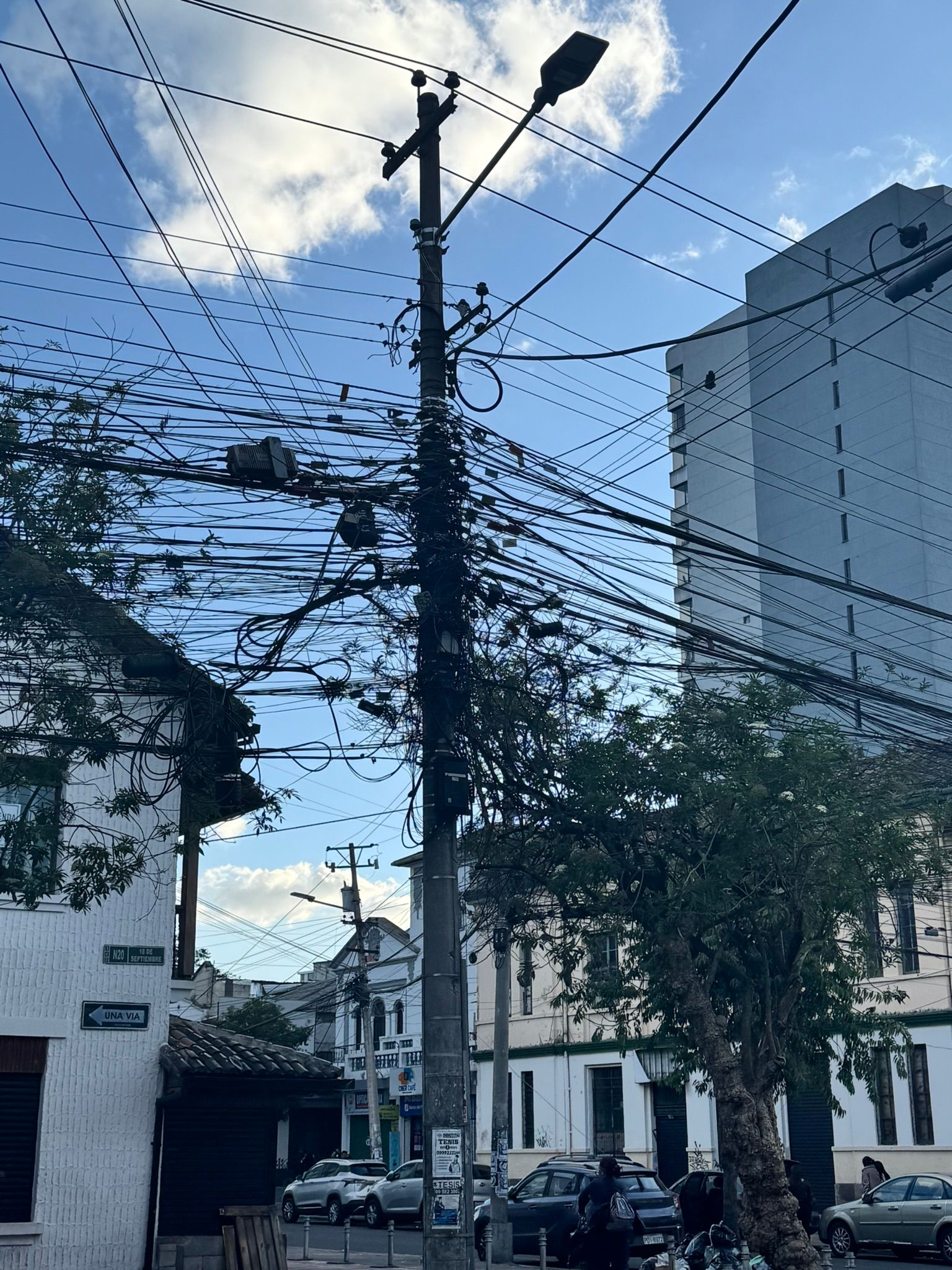
A few weeks ago while we were in Ecuador, we were walking down the street on our way to buy a few souvenirs from our trip. I noticed across the street, what I would call a discombobulated mess of wires running above us. They all met at a single point – an electrical pole. If you've ever spent any time in that part of the world, you'll know what I mean. I'm not the most handy person in the world, and man, it looks like a mess that I would never want to try to address. And, as I looked at these wires going everywhere, I had a thought.
Every single one of those wires was intentional. Somebody needed power, so somebody ran a line — a business, a home, a shop that opened last spring — and every one of those was a good decision made by a person who needed something. Nobody was careless. And, the whole thing is still a mess.
From my experience living in South America, most of the time, the power worked, but there were times the power would stop and we'd have to wait for someone to fix it. It was not nearly as reliable as the power that we have here in the US. And, from looking at that pole, you can only imagine why. If I lost power completely from my house, I can only imagine how long it would take to figure out which line was mine. It really would take days. And the guy who came out probably wouldn't even trace it — why would he? He'd just run another wire.
Here's what I keep thinking about. Nobody ever takes anything down. In reality, there are wires up there that are still live and probably some that haven't fed anything in years. They're all still hanging in the same tangle, making it that much harder to find the one that actually matters. Nobody audits the pole. You just add another line and hope.
Often, we build our lives the same way, one wire at a time. We give power to the places that need it most, and every single line is justified because each one was a yes to something good. Twenty years of that and you've got a pole.
The men I sit with are not careless. In fact, they're excellent providers. That's the thing. At work everything is fine. He leads a team of 10 people. He shows up each day. He delegates responsibilities. And it works. His boss thinks he's doing a fine job and his team does, too. Great salary and benefits. Nice car.
At home it's fine, too. He shows up after work. He is there. He takes his kids to soccer practice and attends their games. He apologizes when something doesn't go as planned. He's going through the motions of life, giving power where he thinks it needs to be…
…and nothing energizes him.
Not bad. Not in crisis. Just fine. The activities with the family are fine. The things he plans with his wife are fine. Nothing he'd ever tell a story about later.
Now, here's what I've come to believe about fine. Everybody that's fine worries about the breeze. You'll get a slight breeze and the entire thing comes tumbling down. Maybe your wife says it to you on the way to another soccer game, and it takes you completely by surprise because you thought things were fine. And they were… until they weren't.
That happens. But it's not what I would worry about most.
What worries me the most? When nothing happens. No breeze. No collapse. Just fine, all the way to the end. Fine isn't a floor you're standing on — it's a ceiling, and a man can spend his entire life underneath it and never have one single thing go wrong.
Eventually your kids will grow up and they'll say, "Dad was good. He was always there. He apologized. But, he wasn't really present. Things in our life were fine. Nothing was ever great."
And, you'll know they're right, because you felt exactly the same way the whole time.
There's still time. Most men don't believe that, so I'll just say it bluntly. Too often we look at all the wires going everywhere and realize that it's just easier to live a fine life, because it's too much work to figure out where all the lines are sending power. And, I don't blame you. Life gets hard. It gets monotonous. The pole really is a mess.
But, too often I'm fine leads to I'm done. Sometimes it's her saying it. More often it's you, quietly, about your own life.
I designed the Wilderness Gap methodology for that man — not the one in crisis, but the one where everything is working and nothing is alive. It's an assessment that makes you stand back and look at the whole pole. Your values first, then how you show up at work, and more importantly, how you show up at home. It won't fix anything by itself. What it will do is show you which lines are live, which ones are dead, and where the distance is between the man you think you are and the man the people around you actually get.
Then we go to work on it. There will be work involved on your part. A lot of it.
But, just imagine what it would be like to say "I'm great."
- See you above the treeline.
P.S. — I'm taking a small group of men to Moab October 22–24. Capped at eight. If you want to talk about whether it's for you, hit reply and we'll find twenty minutes.