
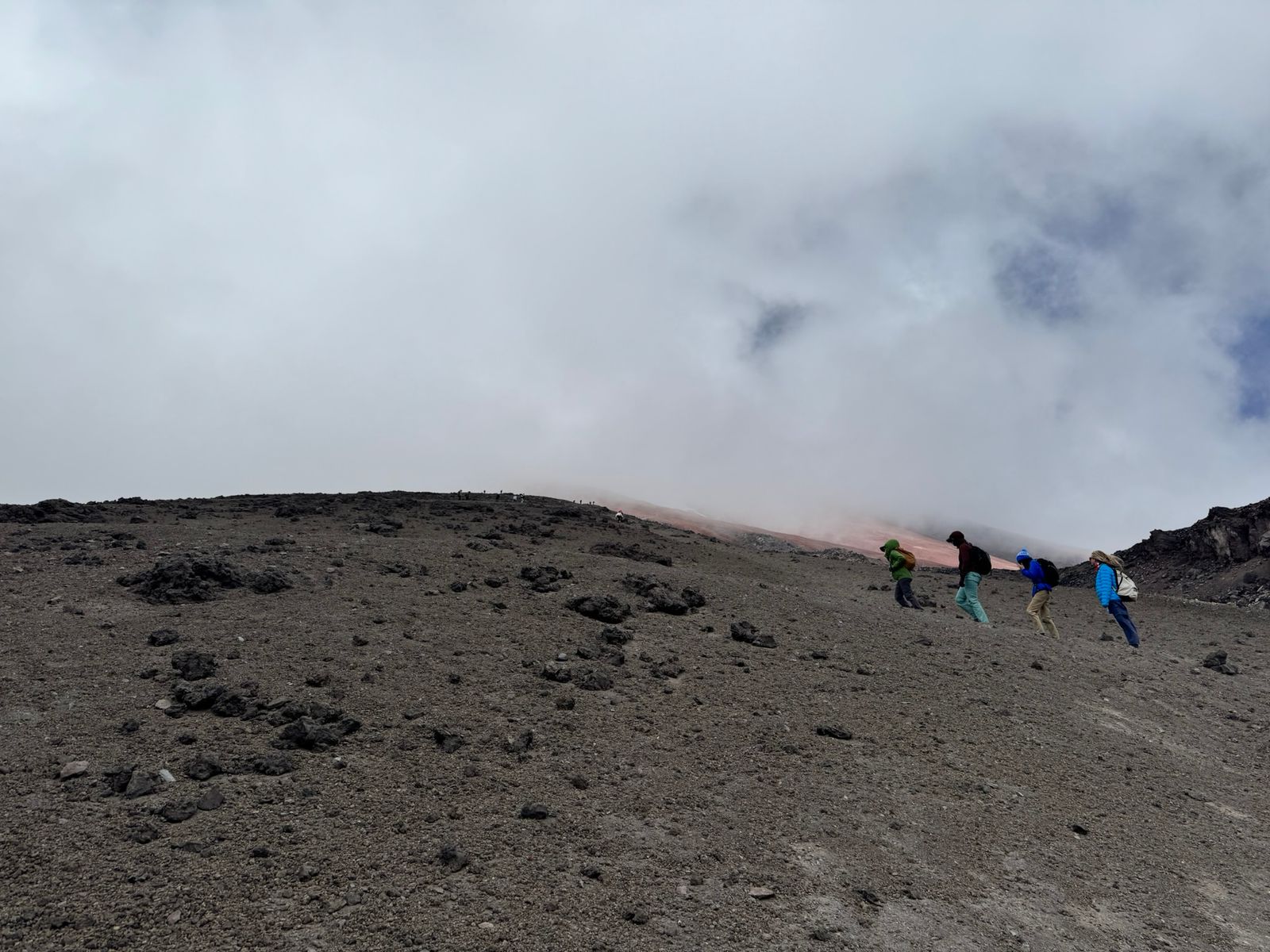
Two weeks ago my family and I were in Ecuador. We spent three days in Quito, a vibrant and wonderful city, and then we drove into the mountains. There we had a much different experience. Instead of nearly 500-year-old churches, we were on the flanks of Cotopaxi, one of the highest active volcanoes in the world.
With a little trepidation about altitude sickness for my wife and kids, we all got out of the shuttle with our guide to start our climb towards the base camp. The hike starts at 14,760 feet. We grabbed our backpacks and set off for the hour-long, one-mile, 1,200-foot climb to the José Rivas Refuge. We zigzagged up the hill. The hiking was slow. The breathing labored. At that elevation you're working with 44% less oxygen than you'd have at sea level. You feel it in about fourty steps. The weather constantly windy and changing from rain and fog, to blue skies, with temperatures steady in the 30s.
Our goal was the refuge, never the summit. Our youngest is 9, and we decided before we ever left the parking lot that the refuge was far enough for him.
I watched as my youngest, leading the group slowly and steadily towards the refuge, battled the rain, wind, and altitude. Every five minutes or so, he would stop, take a breath and ask "How much further?" Each time, we had to comfort him and say, "You're doing great! Keep going!" or "You've got this. Just take a quick break."
We made it to the refuge, a stone hut that sits just under 16,000 feet above sea level. We got out of the rain and wind and enjoyed a warm cup of hot chocolate, dried off, and relaxed.
Then we turned around.
Instead of rain and strong winds fighting each step like we had on the ascent, the storm had cleared and we had blue skies and perfect weather for the descent. My wife and I walked slowly back to the trailhead as we watched our kids hop, slide, and run down through the scree with our guide at their side. It was fun to watch our kids do something hard and love it.
Surprisingly, no one experienced altitude sickness. No headaches. No nausea. Nobody dragging. And we all slept soundly in our beds that night.
The descent is what kills you
Climbers already know this. Ed Viesturs — the only American to climb all fourteen 8,000-meter peaks without supplemental oxygen — put it this way: getting to the top is optional, getting down is mandatory. Everyone repeats it. And people still die on the descent.
Of the climbers who died after going above 8,000 meters on Everest, 56% died coming down from the summit. On Denali, 61% of the deaths happened on the descent. That's a staggering number. People work so hard to actually climb the mountain that they've expended all their energy and don't have enough to make it back to base camp.
The Everest study found something else. The climbers who lived reached the summit hours earlier in the day than the climbers who didn't. The most common thing reported about the ones who died wasn't a storm or a fall. It was exhaustion and confusion. They were too tired to think, and then they made a decision.
The man who made it to the top
In our careers, there really is no summit. Each time we reach a new height, another one magically appears. There's always going to be a better job, a different title, a fancier company, more money, greater revenues, and the list goes on and on. Each climb getting us a bit closer to the top, but then the top moves. Our objective is constantly changing. Yet, in our climb, how often do we decide that we've achieved enough? Do we ever actually decide that the basecamp is sufficient?
When I was in my late 20s and working at a bike shop, I met Richard, from New York City. He walked in to buy a bike and we became instant friends. He had an Ivy League degree and a high-paying job on the stock exchange. He had been divorced a few times and was in Utah looking for something different – a new way of life, a slower pace, and time to reflect. He had a son that was about my age that didn't want anything to do with him. More than once, he told me I reminded him of his son. We talked a lot during his time in Utah. What sticks with me is the regret he had for prioritizing his career over what mattered most.
Clayton Christensen wrote in How Will You Measure Your Life? that people driven to excel "underinvest in their families and overinvest in their careers." That was Richard. He had sacrificed everything that really mattered to get to the top of his career. And, for what? A swanky corner office? A fancy job title? Millions in the bank? He made it to the top. He just didn't have anyone left to come home to.
After he left Utah we kept in touch for a few months, but I've since lost track of him and don't know what ever happened. I have often thought of him, though, and wonder if he ever figured it out with his son.
You set the turnaround time before you climb
Before climbers leave the last camp for the summit, they set a turnaround time – let’s say two in the afternoon. If you're not standing on the summit by two, you turn around, no matter how close you are.
The point isn't the specific hour. The point is when you decide. You make that call in the tent, rested, with oxygen in your blood and nothing on the line. Because the version of you who is 300 feet below the summit at 3:40 in the afternoon, hypoxic and eight hours in, is not a person who can be trusted with that decision. He'll tell you it's only another twenty minutes. He'll be wrong, and he won't know it.
We don't do this with our careers. We wait until we're in it. Until the offer is sitting there, or the funding round is closing, or the promotion is finally on the table after four years, and then we try to decide whether it's worth it — right at the moment we're most tired and least able to see straight.
What I'm still working out
I'm not saying we shouldn't push for the summit. In fact, I'll be going back to Cotopaxi to climb to the summit. Yes, I'm writing about not prioritizing the summit while planning a trip to get to the top. I'll be going alone, without my family. And, my wife is ok with it. If she wasn't, there's no way I'd even try. She knows my limits and helps me stay safe. But, there's still a risk. And we're both ok with it.
We settled that months ahead, at home, when nobody was tired and nothing was on the line. That's the only reason I trust the decision.
I'm not quite sure where we need to draw the line. But I'm more convinced that it needs to get drawn early, before you're tired, and out loud, with the people it affects.
The refuge sits above the treeline. There's nothing growing up there — no trees, no cover, nothing soft. Just rock, wind, and a stone hut with hot chocolate. That was far enough for us.
Let's not forget that it's ok to only make it to base camp.
See you above the treeline.
I'm curious where your line is. Reply and tell me — what's the summit you decided not to climb?